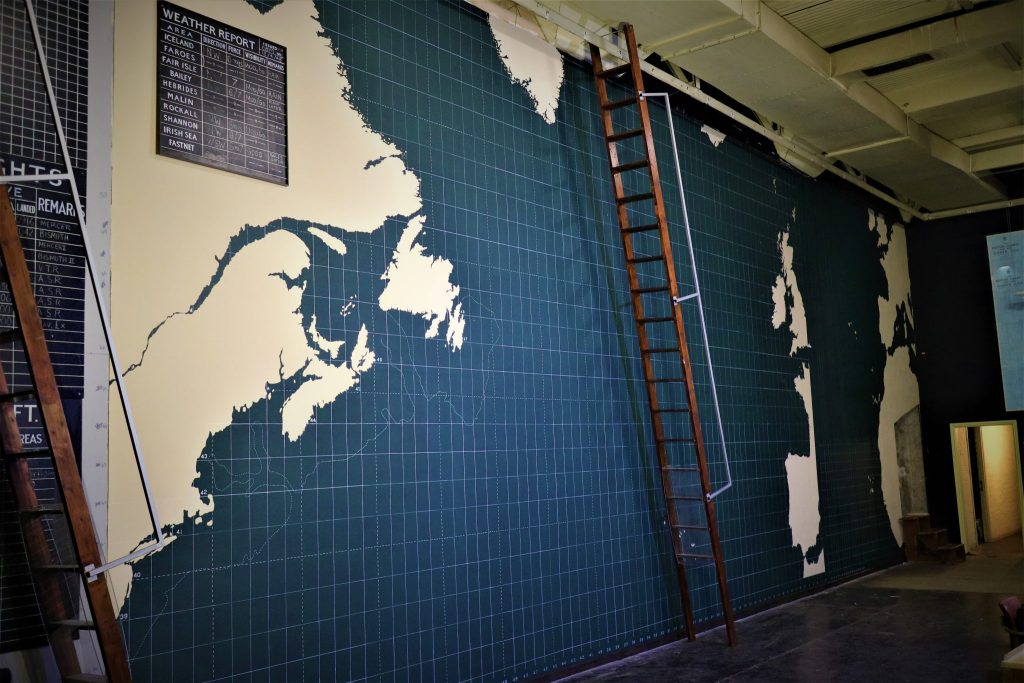
After four months of closure, the Western Approaches bunker in Liverpool reopens with a major surprise in store for visitors.
The sprawling Second World War complex beneath the streets of Liverpool was once the command centre for the entire Battle of the Atlantic campaign. Over 300 staff (mostly young women) worked in the labyrinth of steel and concrete-clad corridors and rooms, their groundbreaking work as significant as that of Bletchley Park. Indeed, its impact was so great, historians have suggested that it is perhaps the single most important surviving building in the world related to the Second World War.
Forgotten for decades, the site was saved from dereliction by non-profit heritage organisation Big Heritage in 2017, turning it into one of Liverpool’s most popular historic sites.
Despite closing in March due to coronavirus, the team launched a series of online engagement activities, including Western Approaches ‘lockdown lessons’ for children, which to date have had over half a million views and led to an impressive 3000% increase in social media followers.
However, as in the war, the real work is going on in secret underground, where a huge restoration project nears completion, restoring an additional 5000 square feet of the site, all previously closed off since the war. It includes sleeping quarters, rooms for decoding messages from Bletchley Park and reactivating a number of wartime teleprinter machines, re-engineered to allow visitors to see and hear them in action for the first time in 75 years.
By far the most significant part of the project has been a complete restoration of the huge 20ft tall Atlantic Plot map, the epicentre of the entire building during the war and on which the route of vital convoy ships were plotted, whilst simultaneously tracking the movement of deadly German u-boats. The original map surface was destroyed in 1945 and hastily replaced in 1990 with an inaccurate and poorly constructed replica, during a brief and unsuccessful attempt to re-open the site as a tourist attraction.
Interviews with the few surviving women who worked on the Atlantic Plot during the war and the discovery of previously forgotten building plans meant that it could finally be carefully restored to its original state. Some documents dating to 1941 were so detailed they listed the shades of paint used and the thickness of the chalk lines used to mark longitude and latitude.
The majority of the restoration cost has been met by a generous donation from the Robert W. Johnson IV Charitable Trust in America, in memory of the late Betty W. Johnson, the American philanthropist and matriarch of the Johnson Family, who passed away on 5th May this year. During the Second World War, Betty enlisted into the US Navy’s WAVE (Women Accepted for Volunteer Emergency Service) and helped train young fighter pilots in flight instrument skills and celestial navigation at Rhode Island’s Naval Air Station, a role equivalent to that played by the women of Western Approaches.
Dean Paton, founder of Big Heritage and Director at Western Approaches said “It has been an uncertain time for all heritage sites, but we have used lockdown to broaden our engagement to new audiences online and undertake more restoration work in the bunker. With support from the Johnson Charitable Trust, we have been able to restore one of the most important historical rooms in the world back to its former glory.”
Mr Paton continued “It is most fitting that the donation was made in memory of Betty Johnson. At the same time that she was serving her country and helping to train US pilots during the war, the women of Western Approaches were working in this very building, training Navy captains in anti-submarine warfare. In an era when women were still deemed less capable than men, Mrs Johnson and our Wrens were demonstrating that they could rise to any challenge thrown at them.”
The relationship between Western Approaches and the Johnson Charitable Trust was forged in February this year, when Woody Johnson, Betty’s son, visited Liverpool in his role as US Ambassador to the United Kingdom. On a whistle-stop tour of the city, a brief visit turned into an hour and a half spent exploring the site, even sitting in and chatting to local school children who were visiting that day on a school trip.
Ambassador Woody Johnson said: “I can think of no better tribute to my mother than to restore a vital artifact which illustrates the human ingenuity and sheer determination demonstrated by Allied forces and, in this instance, by the female volunteer corps during WWII. Mom would be pleased and proud to be associated with her esteemed counterparts in Liverpool.”
As a post-covid Western Approaches prepares to once again reopen to the public, it seems that it has seen off another (albeit invisible) enemy, gained a huge new group of supporters, and with the help of an American ally, is looking forward to a bright future.
Western Approaches re-opens to the public 7 days a week from 1st August. Booking is strongly recommended to avoid queues